Animals That Grow Back

Lucas Schneider
| 11-05-2026
 · Animal Team
Lose an arm, grow a new one. It sounds like something out of a superhero story, but for certain animals, it's just biology.
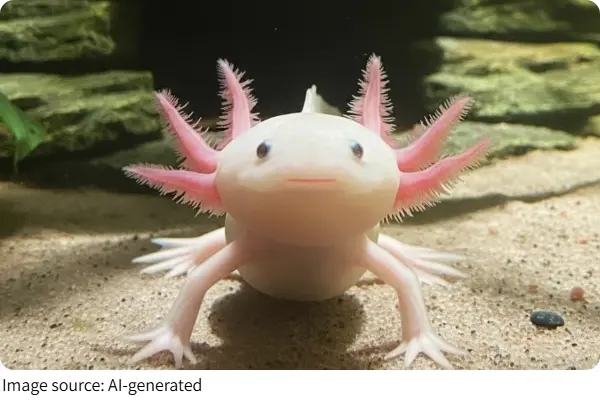
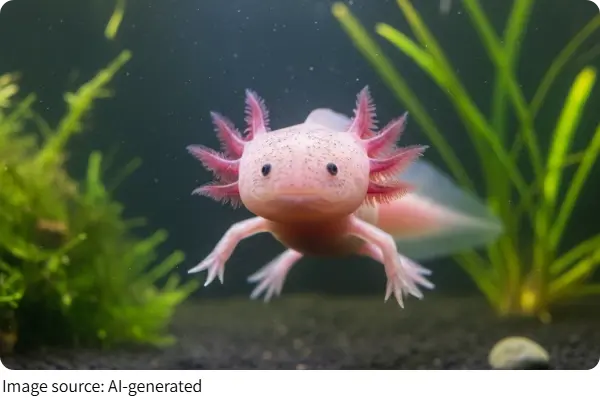
The axolotl — a small aquatic salamander native to Mexico — can fully regrow a severed limb, including all the muscle, nerves, and connective tissue, in a matter of weeks. It can do this repeatedly, throughout its entire life.
And now, Harvard researchers have cracked open a key part of the mechanism behind how it actually works.
Among vertebrates, salamanders stand alone in this ability. Some invertebrates — like planarian flatworms, which can regenerate an entire body from just a small fragment of tissue — go even further. But when it comes to four-limbed animals with backbones, the salamander is the only one that can pull off full limb regeneration.
The Blastema: Where Regeneration Begins
When a salamander loses a limb, the injury site doesn't just scar over the way it would in a human. Instead, the wound forms a specialized structure called a blastema — a lump of dedifferentiated cells that essentially reverts to a more primitive, flexible state. From that blastema, the cells then re-specialize and gradually rebuild the missing structure from scratch, complete with proper patterning, joint formation, and nerve connections.
This process has been studied for over a century, but the full picture of what coordinates it remained elusive. One key mystery was why amputating one limb seemed to trigger a cellular response throughout the entire body — even in uninjured limbs and organs nowhere near the wound.
Adrenaline and the Fight-or-Flight Response
A Harvard research team spent more than six years working out that mystery, and their findings were striking. The whole-body response turns out to be driven by the adrenergic signaling network — the same system better known as the "fight or flight" response, involving hormones like adrenaline and noradrenaline. When a limb is severed, this system activates stem cells and progenitor cells across the body, not just at the injury site.
The effect is essentially a bodywide priming. Other uninjured limbs become ready to regenerate more quickly, which makes practical sense — salamanders in the wild frequently lose multiple limbs to predators or to each other, and being pre-loaded for rapid response is a clear survival advantage. The activated cells also reconfigure their DNA architecture, making certain regeneration-related genes easier to switch on if needed.
That priming doesn't last indefinitely though. The researchers found it only persisted for a few cell cycles before fading — likely because sustaining it requires too much metabolic energy.
Why Humans Lost This Ability — and Whether It Can Be Recovered
The evolutionary backstory here is interesting. Some researchers believe the ancient common ancestor of all tetrapods — the group that includes amphibians, birds, and mammals — could actually regenerate limbs, and that this ability was gradually lost in most lineages over time. Humans still carry the genes involved in limb development. The same genes that build fingers and legs in a human embryo are present in adults too. They just aren't activated once development is complete.
What makes the Harvard findings particularly relevant is that adrenaline exists in humans too. The signaling pathways involved in axolotl limb regeneration use molecular machinery that isn't entirely foreign to our biology. That raises the real possibility of eventually co-opting some of these mechanisms — figuring out which switches to flip, and in what order, to coax human tissue toward regeneration rather than scarring.
Salamanders aren't the only animals pointing the way. Starfish can not only regrow a lost arm — in some species, a single detached arm can regenerate an entirely new body. Zebrafish regrow heart tissue with minimal scarring. The diversity of regenerative strategies across the animal kingdom suggests there are multiple biological pathways to the same endpoint.
The axolotl, though, remains the clearest window into what's possible for vertebrates. And increasingly, what's possible for us.