Shapes Become Art

Camille Dubois
| 15-08-2026
 · Art Team
Hello, Lykkers! Sometimes, the most fascinating photographs are created from the simplest objects. A vase, bowl, bottle, or sculptural vessel may seem ordinary at first glance, but place several geometric forms together, introduce thoughtful lighting, and suddenly the objects become something much more expressive.
Geometric still-life photography is about discovering beauty in shape, proportion, texture, and space. It encourages us to slow down and notice details that everyday life often makes invisible.
Why Geometric Vessels Make Compelling Subjects
Geometric vessels are naturally suited to still-life photography because they contain strong visual structures.
Cylinders, spheres, cones, cubes, curves, and sharp edges can create a fascinating contrast within a single composition. A tall bottle beside a rounded bowl, for example, creates an immediate difference in height and shape. Repeating similar forms can establish rhythm, while contrasting forms can create tension and visual interest. The objects don't need to be expensive or elaborate. Their appeal often comes from their simplicity.
Composition Is the Starting Point
A successful still life begins with thoughtful placement. Instead of simply arranging objects in a row, consider how their shapes interact with one another.
Try placing a larger vessel behind a smaller one to create depth. Overlapping forms can make the composition feel connected, while leaving space between objects can create a calmer, more minimalist appearance.
The rule of thirds can be useful, but it shouldn't be treated as an absolute requirement. Geometric subjects can also work beautifully with centered, symmetrical compositions.
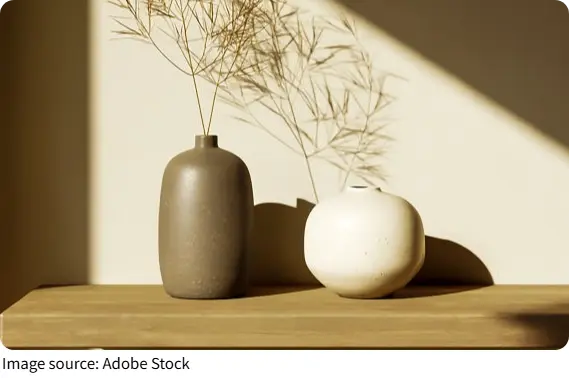
Light Reveals the Shape
Lighting is one of the most important elements in geometric still-life photography. The direction, intensity, and softness of light can completely change how a vessel appears.
Side lighting can emphasize curves and edges by creating strong highlights and shadows. Softer frontal light can produce a cleaner, more delicate appearance. A single directional light source can also create dramatic shadows that become part of the composition themselves.
Pay attention not only to the objects but also to the shadows they cast.
Explore Light and Shadow
Shadows can transform a simple arrangement into something almost architectural. A vessel with a distinctive opening or curved surface may cast an unusual shadow, creating a secondary shape within the photograph.
Experiment with the distance between the light source and the objects. Moving the light can change the size and softness of shadows, giving you different visual possibilities without changing the objects themselves.
Color Can Change the Mood
Color plays a powerful role in still-life photography. A collection of neutral vessels can create a sophisticated and understated image, while carefully selected colors can produce a more energetic composition.
You can choose objects with complementary colors or work with different shades of the same color. Another option is to keep the vessels neutral and introduce color through the background or lighting.
The key is consistency. Too many unrelated colors can distract from the geometric forms.
Texture Adds Another Dimension
Shape may be the star of geometric still life, but texture gives the photograph another layer of interest. Rough ceramic, smooth glass, polished metal, and unfinished stone can all reflect light differently.
Close-up photography can reveal tiny imperfections and surface details that might otherwise go unnoticed. These characteristics make the objects feel more tactile and authentic.
Experiment With Perspective
Changing the camera position can dramatically alter the composition. Photographing from above emphasizes openings and interiors, while shooting at the vessel's level can make the object appear stronger and more monumental.
A lower camera angle can exaggerate height, while a close perspective can emphasize curves, edges, and textures.
Try several viewpoints before deciding which one best communicates the character of the arrangement.
The Bottom Line
Geometric still-life photography proves that compelling art doesn't always require complicated subjects. With a few simple vessels, thoughtful composition, controlled lighting, and a willingness to experiment, you can create images that feel sophisticated and visually powerful.
Start small. Move the objects, change the light, try a different angle, and leave some space around your subjects. You may discover that the beauty you were searching for was sitting quietly on the table all along.