Mountain Biking Basics

Bianca
| 22-10-2026
 · Sport Team
Have you ever wondered how experienced riders stay calm on rocky, root-covered trails? Much of it comes down to the right equipment, solid technique and good trail knowledge.
This article covers how to choose a bike and safety gear, read trail difficulty ratings, brake and handle obstacles, and share paths politely with other trail users.
Choosing a Bike
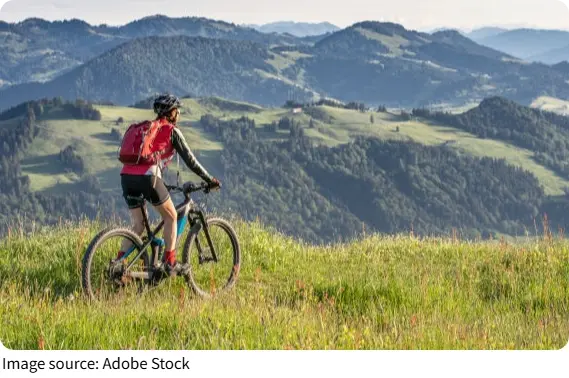
Mountain bikes are grouped mainly by suspension design, which decides how the frame responds to trail impacts. Hardtail bikes have a front suspension fork and a rigid rear triangle. This makes them lighter, mechanically simpler and efficient at sending pedaling force to the rear wheel.
Beginners often start on hardtails because the rigid rear end gives direct feedback from the trail, which teaches good line selection and body positioning. Full-suspension bikes add a rear shock. Its linkage compresses over uneven ground, improving traction and control on rough, technical surfaces and reducing fatigue on long rides.
Essential Safety Gear
Before trail riding, a standard gear checklist starts with a certified mountain biking helmet that gives extended coverage at the back of the head. Full-fingered padded gloves protect hands from abrasions and reduce vibration from the grips.
Flat pedal shoes combine stiff soles for power transfer with soft, grippy rubber that holds onto metal pedal pins. Finally, a hydration pack carries enough water plus spare inner tubes, a compact pump and a multi-tool for trail repairs.
Understanding Trail Difficulty Ratings
Many trail networks use a color-coded system to show technical difficulty, physical effort and expected obstacles. Green circle trails are for beginners, with wide paths, gentle gradients and smooth dirt with few obstacles. They offer a predictable place to practice basic pedaling and steering.
Blue square trails are intermediate, with steeper climbs, tighter turns and natural obstacles such as embedded rocks, exposed roots and narrow sections that need precise steering.
Black diamond trails are advanced terrain for experienced riders. Expect big elevation changes, large unavoidable drops, loose surfaces, off-camber sections and complex rock gardens that demand strong handling and braking skills. Checking the rating at the trailhead helps match a route to your skill, bike and fitness.
Body Position and Braking Technique
Staying stable means constantly adapting your body position to the slope. On steep descents, lower the saddle to make room to move and shift your weight back over the rear wheel. Keep the pedals level and your elbows and knees slightly bent so they act as extra shock absorbers.
Good braking relies on weight transfer. The front brake provides most of the stopping power, while the rear brake mainly keeps the bike stable. To slow down efficiently, use both brakes together with slightly more pressure on the front lever, and shift your weight back so the rear wheel does not skid and the front wheel does not lock.
To try it, practice feathering the brakes on a flat paved surface: apply and release light pressure quickly instead of pulling hard. This teaches you the exact bite point of the brake pads before you ride on loose dirt.
Reading Trails and Navigating Features
Scanning ahead gives you time to adjust speed and pick a line through obstacles. Train your eyes to look several meters down the trail rather than at the front tire. Over roots and rocks, keep your momentum and lift the front wheel by pulling up on the handlebar while shifting your weight back.
For small drops, approach at a steady, controlled speed, push the bike forward beneath you as the front wheel leaves the edge, and use your arms and legs to soak up the landing. Spotting features early lets you handle them smoothly, without sudden steering corrections or panic braking that cost traction and momentum.
Following Proper Trail Etiquette
Shared multi-use trails rely on right-of-way rules that prevent collisions and help keep public land open to riders. The main rule is that downhill riders yield to uphill riders. Restarting on a steep climb takes a lot of effort, so descending riders move to the side and stop to let climbers pass.
When coming up behind hikers or slower cyclists, slow down well and announce yourself clearly, by calling out or ringing a bell, before passing safely on the left. Staying on marked trails limits environmental impact, prevents erosion and keeps the path from widening.
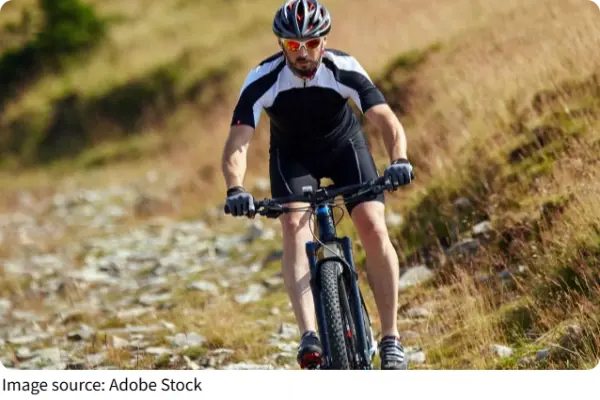
Start with a few rides on green circle trails, where scanning ahead, braking with both levers and yielding to climbers can become habits before you move up to blue square routes.